The Terzieri
Mezule, Fraporta, Santa Maria
As in medieval Narni, today the Corsa all’Anello still sees the city divided into three Terzieri, which share out the area within the historic walls: Mezule, the upper zone towards the Rocca; Fraporta, the city center between Piazza dei Priori and the Cathedral; and Santa Maria, from the ancient church of Santa Maria Impensole to Porta Polella. The Terzieri are now true hubs of community life and key reference points for residents—vibrant places animated by the dedication and professionalism of citizens and volunteers who contribute, year after year, to the success of the festival.
Each Terziere has its own stable, where the horses and riders of the Corsa all’Anello prepare and train in well-equipped facilities. The women of the Terzieri, meanwhile, work in tailoring workshops under the guidance of historical costume designers to create the garments for the grand procession. Each costume is the result of careful iconographic and documentary research into fabrics, styles, and figures of the time, combined with the craftsmanship of skilled hands capable of transforming cloth into authentic 14th-century attire. The result is a historical parade that offers a spectacle remarkably close to the life of an Umbrian community in the 14th century. Young members of the Terzieri come together to prepare the medieval days, studying scenes, settings, performances, and dramatizations, leading to the creation of true tableaux vivants inspired by the works of the great painters of the 14th century.
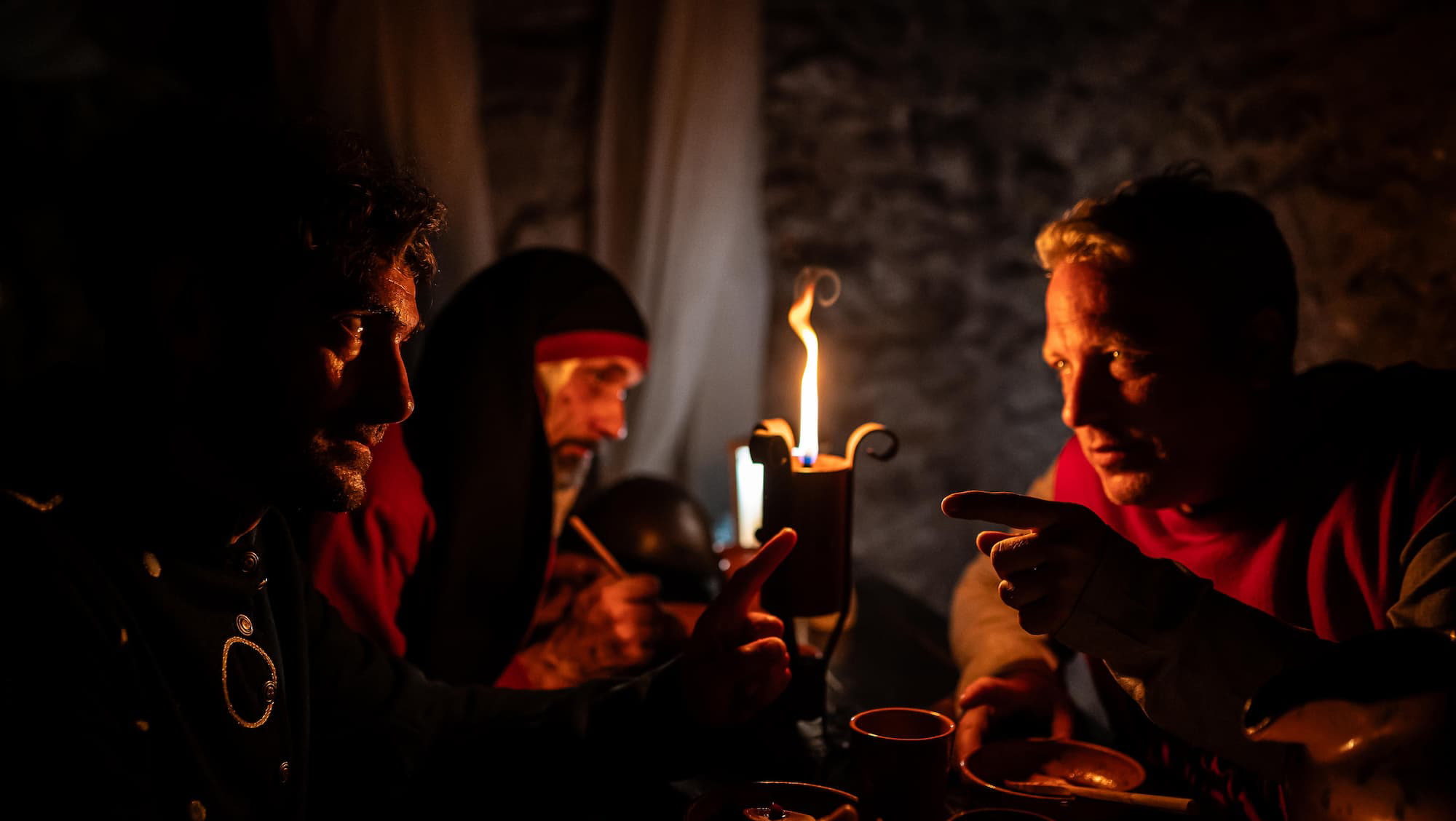
Parades, costumes, settings, and medieval days are all part of a competition that culminates in the awarding of the Bravio to the best Terziere—a banner painted each year by a contemporary artist and granted by a panel of experts. The taverns, finally, represent the place of conviviality: evocative spaces set up with furnishings inspired by the past, where medieval atmospheres blend with the authentic flavors of tradition.
The Ladies of the Rings

Mezule

Fraporta

Santa Maria
Why are they called “Terzieri”?
The names of the three Terzieri are recorded in historical documents: Mezule, Fraporta, and Santa Maria—familiar names, well known to all. But what is their true origin? The answer is closely tied to the historical division of the urban territory. However, especially in the early years of the modern re-enactment of the Corsa all’Anello, there were uncertainties in interpreting their etymology. These ambiguities led, over time, to a curious error not only in theory but also in geography—corrected only partially from a historical perspective, but never entirely in terms of territorial distribution. The Terziere of Santa Maria takes its name from the church of Santa Maria Maggiore (later San Domenico), located along what is now Via Mazzini. For some years, however, this name was mistakenly associated with the church of Santa Maria Impensole, consequently shifting the boundary of the Terziere much further uphill than its historical location. Toponymy instead provides a valuable key to understanding the Terziere of Mezule, whose name clearly refers to the “middle” of the city. This raises an obvious question: how is it possible that today this Terziere identifies the upper part of the historic center?
The misunderstanding arose during the modern reconstruction of the boundaries. When reinterpreting the sources, the founders of the festival redrew the Terzieri, relying in part on the interpretation of the name Fraporta, which was mistakenly understood as the area between Porta Ternana and Porta Romana. This led to a chain of incorrect deductions, ultimately identifying the Terziere of Mezule—by exclusion—with the remaining area: the upper part, beyond Piazza del Lago toward the Rocca, a reference that still appears today on its banner. To further complicate matters, the current Porta Ternana (known as delle Arvolte) is a structure built after the Middle Ages and therefore cannot be linked to the original etymology of the Terziere. In reality, the name Fraporta (sometimes recorded in 16th-century documents as Foraporta) derives from the preposition Infrà, which in medieval Latin means “below” or “under.” The “porta” referred to is not a modern city gate, but rather the Roman Arch, historically known as Porta Superior—the main access to the city from the Via Flaminia. The part of the city described as infra portam, that is, beyond or below this gate, actually corresponds to the upper section of the historic center, beyond Piazza del Lago. Thus, the mystery is revealed: the names and historical locations of the two traditionally rival Terzieri, Mezule and Fraporta, should in fact be completely reversed according to their true historical and toponymic origins.
Discover more about the Terzieri
Click on the Terzieri logos to learn more…
-

Mezule
Il Terziere Mezule, o Parte De Sopra, si colloca poco sopra piazza Garibaldi estendendosi fino alla Rocca dell’Albornoz; nascosto al grande flusso, conserva ancora oggi la tipicità e le caratteristiche del Borgo Medievale. Il suo vessillo è una Torre Nera in campo Bianco. L’ingresso principale del Terziere, celato da altrui vessilli, si inserisce nell’antico tracciato della via Flaminia (oggi via XX Settembre), che tortuosa da Piazza Garibaldi sale il monte e si dirama in un groviglio affascinante di vicoli e stradine con scale e ciottoli, sul percorso vale la pena soffermarsi ad ammirare il Palazzo dei Conti Mancinelli in via Aspromonte, il suggestivo scorcio con archetto in cotto del 1400 in via del Monte, la Chiesa di S.Margherita, per finire con l’imponente Rocca Albornoziana e durante i festeggiamenti gli Ambienti Medievali. Molti di questi ambienti medievali ricostruiti abilmente dai volontari, sono negli anni divenuti il “palcoscenico” perfetto per le apprezzatissime rappresentazioni delle Giornate Medievali di Mezule, vero e proprio fiore all’occhiello del Terziere, che negli anni ha raccontato veri e propri episodi della storia trecentesca narnese attraverso coinvolgenti e spettacolari scene di teatro di strada. Per il visitatore che entra a Narni, il Terziere Mezule non è immediatamente visibile, ma con un po’ di fortuna si scopriranno i suoi vicoli e le sue piccole piazze e con esse le taverne del Terziere… L’Hostaria, L’Aquila Nera, le Stranezze e l’antichissimo forno che ininterrottamente dal Medioevo ad oggi ha continuato a diffondere nell’aria profumo di pane e pizza. All’interno di caratteristici locali, la consolidata tradizione Mezulana nell’arte della cucina propone piatti della cucina tipica Umbra e pietanze dal gusto Medioevale che negli anni hanno conquistato i commensali in visita alle Osterie del Terziere. Nelle taverne illuminate anche dalla luce delle candele in un connubio fra cibo, canti e poesia, sarà data ai partecipanti la possibilità di vivere l’essenza del Medioevo.
-

Fraporta
E’ il Terziere che occupa la parte centrale della città, caratterizzata essenzialmente dalle due piazze principali, dai monumenti storici del Paese e dall’imponenza del Duomo. Il suo vessillo dai colori Rosso/Blu presenta al centro una porta d’ingresso bianca. Il comitato del terziere è attualmente costituito da una nuova generazione di contradaioli, agguerriti ed ambiziosi, desiderosi di rinnovare la gestione del terziere, nella conferma delle sue grandi tradizioni. Il così detto “Palazzo Fraporta” è recentemente divenuto il punto d’incontro di tutti i simpatizzanti del Terziere. Avendo a disposizione le due piazze principali della città, il terziere Fraporta ha utilizzato al meglio questi ampi spazi per riproporre allo spettatore apprezzatissimi spettacoli di danza o suggestive scene di massa, coinvolgendo anche vari costumanti tra nobili e popolani. Durante gli oltre 15 giorni di festeggiamenti, per allietare in allegria e libertà le serate dei graditi turisti visitatori, sono allestite dal Terziere Fraporta l’ Hosteria, il Forno e Lo Dolce, per soddisfare tutti i gusti e tutte le esigenze. Nel corteo del terziere, spiccano il gruppo tamburini, vincitore di numerosissimi premi, nonché gli stendardi dei castelli, dipinti da giovani artisti narnesi ed il gruppo dei musici medievali. Tutti i costumi sono realizzati artigianalmente nella sartoria interna, vero punto di forza del Terziere. Grazie alla abilità e alla passione delle sarte contradaiole, vengono confezionati veri e propri gioielli sartoriali, nel pieno rispetto dell’iconografia e documentazione storica. Per quanto riguarda l’ambiente, spicca all’occhio la ricostruzione della Via dei Mercanti (oggi via dei Priori) con i grandi portali di legno tipicamente medievali, la suggestiva illuminazione con candele della chiesa di S.Francesco, dove si svolge ogni anno la tradizionale cerimonia di investitura dei cavalieri giostranti, e l’imperdibile imbandieramento di via del Campanile, scorcio emozionante del terziere, ma anche Speziale e Orto Medievale ricostruito abilmente nello spazio retrostante l’abside gotico di S. Francesco, affacciato sulle splendide Gole del Nera.
-

Santa Maria
The Terziere of Santa Maria encompassed—and still encompasses—the northwestern part of the city of Narni, which at the time was the most important area, as it was crossed by the Strata Maior (today divided between Via Marcellina and Via Mazzini), along which still stand some of the richest and most significant noble palaces. Palazzo Scotti, Palazzo Arca-Marinata, the Torre dei Marzi, Palazzo Cardoli, and Palazzo Capocaccia display their splendid mullioned windows and magnificent portals along this noble street. It is also home to important religious buildings: Santa Maria Maggiore (from which the Terziere takes its name and emblem—a black church on an orange field), the ancient cathedral later used as the “winter” cathedral in contrast to the “new” one outside the walls dedicated to San Giovenale, and Santa Maria Impensole, another very ancient church built on the ruins of a temple of Bacchus, once a meeting place for the city’s guilds. Completing this remarkable ensemble of medieval buildings (excluding later constructions such as Palazzo Bocciarelli and Palazzo Mosca, both at the beginning of the street, and the church of Santa Restituta) are the gates that once marked access to the city walls: Porta Nova (so called after the sack by the Landsknechts in 1527), also known as Porta della Fiera, Porta dei Polelli, and Porta del Vodano. Before reaching Porta Nova, one can also observe a site of historical—rather than artistic—interest: the house of Erasmo da Narni, a valiant mercenary captain known as Gattamelata, either for his gentle manners or after his mother, Melania Gattelli. Thanks in part to the magnificent equestrian statue by Donatello in Padua, which immortalizes him on horseback, the name of Narni remains—and will remain—linked to this commander, as he himself liked to recall: “Narnia me genuit, Gattamelata fuit.”